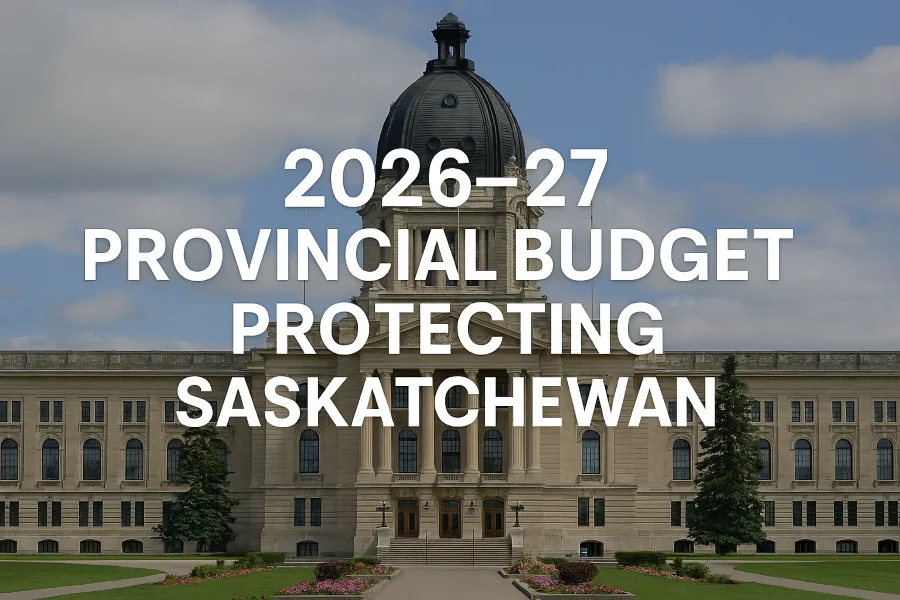
Saskatchewan Releases 2026‑27 Provincial Budget Focused on “Protecting Saskatchewan”
The Saskatchewan government released its 2026‑27 provincial budget on March 18, outlining a plan that emphasizes affordability, expanded health care access, community safety and economic stability.
The province is forecasting $21.4 billion in revenue and $22.2 billion in spending, resulting in an $819‑million deficit.
Finance Minister Jim Reiter said international tariffs and global instability have strained finances, though he argued Saskatchewan remains well‑positioned compared to other provinces.
Affordability measures have been framed as a central priority, particularly as residents across Regina and other Saskatchewan communities continue to face rising living costs, ranging from utilities and insurance to rental prices.
The budget includes more than $2.5 billion in measures such as increased personal tax exemptions and a five per cent boost to the Low‑Income Tax Credit. The province says these changes amount to about $200 million in savings this year and raise the threshold at which a family of four begins paying income tax to $65,000.
While the government highlights these measures as meaningful relief, some economists and policy analysts caution that structural affordability issues, particularly in housing and municipal taxation, may dilute the impact.
Experts worry that Saskatchewan’s deficit is expected to persist until 2030, suggesting affordability pressures may continue unless the province’s revenue outlook improves.
Economic development remains another key component of the budget, which preserves the province’s one per cent small business tax rate. For Regina, where the downtown core has faced slow post‑pandemic recovery and business turnover, this may help support local entrepreneurship.
The province is also planning $17.5 billion in capital investments over the next four years. Business groups are expected to welcome infrastructure spending as a stabilizing force during economic uncertainty, though some analysts note that large‑scale construction projects could face cost escalations given inflation and supply chain pressures.
Health care continues to command the largest share of the budget at $8.5 billion. The Patients First Health Care Plan includes expanded primary care access, more urgent care centres, and improved diagnostic services, areas of persistent concern in Regina, where emergency room wait times and physician shortages have drawn public frustration.
Experts and health sector representatives have emphasized that funding increases alone may not resolve long‑standing workforce challenges. Last year, health professionals interviewed by Global News, including Saskatchewan physicians and nurses, stressed the need for stronger staff retention strategies. Dr. Adam Ogieglo noted that retention tools remain limited, and health unions have flagged that staffing shortages continue to strain emergency departments and rural areas. Analysts say these concerns remain relevant, as many of the same pressures persist into 2026.
Some health policy commentators have pointed out that Saskatchewan’s healthcare system has struggled with overtime costs, contract nurse reliance and capacity pressures, issues highlighted in previous budget cycles.
Community safety initiatives in the budget include increased support for RCMP operations, First Nations policing and a new Small Town and Rural Policing Grant Program. For communities surrounding Regina, whose residents have frequently raised concerns about property crime and response times, these investments may be welcomed.
However, some criminologists argue that long‑term safety improvements require simultaneous investments in housing, mental health and addictions supports, areas where demand has outpaced available services province‑wide.
The budget includes new investments to support vulnerable people, such as expanded shelter spaces, supportive housing units and increased benefits for residents on Saskatchewan Assured Income for Disability and Saskatchewan Income Support.
For Regina, where homelessness has become more visible and shelters often operate beyond capacity, these measures may provide some relief. Yet experts note that creating 40 new provincial shelter beds is unlikely to meet the full demand, especially during winter months when urban centres experience peak need. Many community agencies say sustainable, long‑term funding for supportive housing remains the greater challenge.
Education funding will rise to $2.5 billion, but stakeholders have long called for more clarity around classroom supports and long‑term staffing. While Regina does not receive new school construction projects under this budget, expanded specialized support classrooms may help address behavioural and learning needs that teachers have identified.
Post‑secondary institutions, including the University of Regina, will benefit from stable four‑year funding increases and tuition caps.
Financial analysts observing the budget note Saskatchewan retains a comparatively strong fiscal position, including the second‑lowest debt‑to‑GDP ratio among provinces. But the province’s plan to return to balance relies heavily on economic growth and workforce attrition rather than program cuts.
Experts warn that if global conditions worsen or resource revenues soften, the province may face difficult decisions sooner than anticipated.
From a resident’s perspective, the 2026‑27 budget lands in a moment where Saskatchewan communities, especially Regina and Saskatoon, are seeking tangible improvements in health care access, rising living costs, safety concerns and supports for vulnerable populations.
Whether the measures outlined will meet those expectations will become clearer in the months ahead, as both economic conditions and service demands continue to evolve.
No comments on this post yet. Be the first!